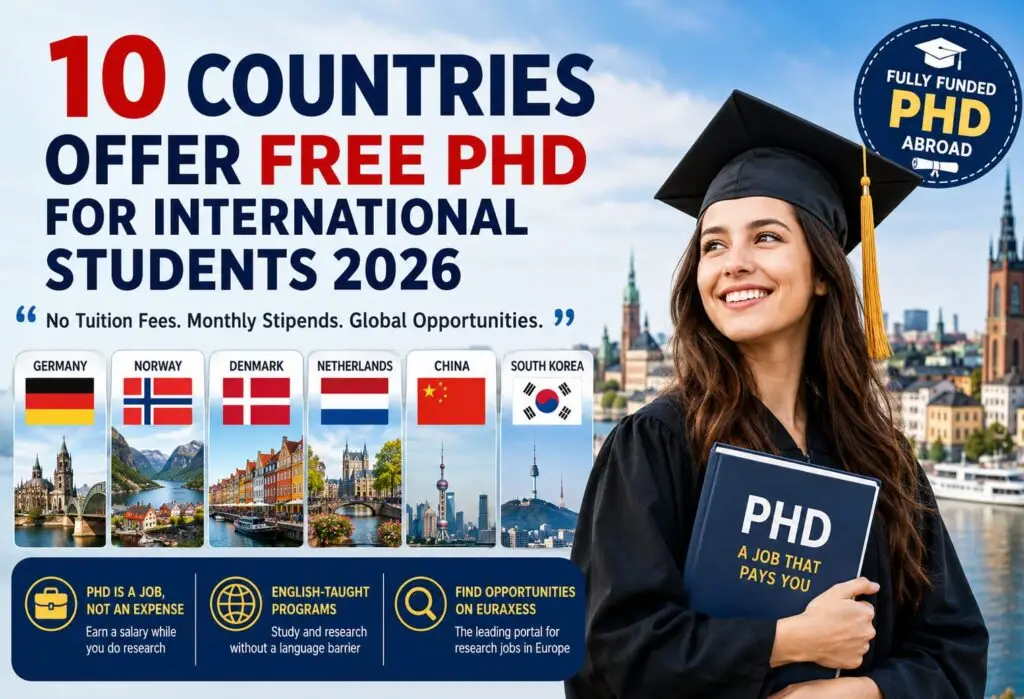
Let me be honest with you — when I first heard that some countries give international students a full PhD at zero cost, I thought it was too good to be true. No tuition fees. A monthly salary deposited into your bank account. A world-class degree at the end of it. Surely there had to be a catch. There isn’t. At least, not in the manner you are likely envisioning.
10 Countries Offer free PhD for international students 2026

The reality is that in many parts of the world, a PhD is not treated like a student programme — it’s treated like a job. You are hired as a researcher. You sign an employment contract. You get paid. And in return, you produce research that contributes to the country’s academic and scientific output. That’s the model. And if you understand that model, you can absolutely take advantage of it — completely legally and ethically — as an international student.
This guide breaks down the top free PhD for international students — places where tuition is either zero or covered, and where you receive a stipend to cover your living costs. We’ll also look at what each country actually offers in practice, because the devil, as always, is in the details.
What does ‘free PhD’ actually mean?
Before we dive into the list, it helps to be clear about terminology. When we say ‘free PhD for international students,’ we typically mean one of two things:
- No tuition fees — you are admitted to a PhD programme and pay nothing for instruction or supervision.
- Funded positions — you are hired on a contract that covers your fees and pays you a monthly stipend on top.
The best opportunities combine both. In countries like Germany and Norway, PhD positions are employment contracts — you don’t just study for free, you actually get paid a proper salary. In others like Finland or France, the situation varies by university and funding source, but free or heavily subsidised options exist.
10 countries where you can do a PhD for free — with stipend
GERMANY · EMPLOYMENT CONTRACT
Germany — The Gold Standard for Funded PhDs
€1,500–€2,200/mo
DAAD Available
Germany is probably the most well-known destination when it comes to free PhDs for international students, and for good reason. Public universities in Germany charge no tuition fees — not for locals, not for international students. That policy applies to doctoral programmes too.
More importantly, most PhD positions in Germany are funded through research contracts (wissenschaftlicher Mitarbeiter). These are actual employment contracts, typically at 50–75% of the TV-L E13 salary scale, which works out to roughly €1,500–€2,200 per month net. You pay into Germany’s social security system, you get health insurance, and you build pension contributions. It’s a real job.
The main challenge is finding an open position and convincing a professor to take you on as their doctoral student. Most positions are advertised on university websites, EURAXESS, and academics.de. DAAD scholarships are also a strong backup route if you don’t find a direct position.
NORWAY · GOVERNMENT SALARY
Norway — Fully Salaried PhD, No Exceptions
€44,000/year
4-Year Contract
Norway takes things one step further. Every PhD position at a Norwegian university is a fully salaried, four-year government employment contract. No exceptions. The stipend sits at approximately NOK 500,000 per year — that\’s roughly €44,000 annually before tax, which after Norwegian income tax leaves you with a very comfortable living wage even in an expensive city like Oslo.
There are no tuition fees in Norway for PhD students regardless of nationality. Norwegian PhD researchers also benefit from full access to the national health system, parental leave policies, and union protections. International applicants are welcome across virtually all disciplines, and English-language research environments are the norm — you don’t need to speak Norwegian to thrive here.
SWEDEN · EMPLOYMENT MODEL
Sweden — PhD as Employment, Not Study
€2,600–€3,100/mo
Highly Competitive
Sweden operates on the same employment-based PhD model as Norway. Doctoral students are formally employed by the university and receive a monthly salary under a collective bargaining agreement. Starting salaries range from SEK 30,000–36,000 per month (around €2,600–€3,100), and they increase progressively each year you complete.
Swedish PhD programmes typically run for four years and cover tuition entirely. The catch — and this is a real one — is competition. Sweden\’s funded PhD positions are highly sought after and advertised globally. Your academic record, research proposal quality, and the fit with a supervisor\’s ongoing project all matter enormously.
FINLAND · DOCTORAL PILOT
Finland — Free Tuition with Research Funding
€2,000–€2,400/mo
STEM Focus
Finland abolished tuition fees for EU students and maintains relatively low or no fees for PhD candidates in many institutions. The Finnish doctoral system recently restructured into a four-year funded model through doctoral education pilots across universities. Funded positions come with a monthly stipend of roughly €2,000–€2,400 and include social security benefits.
Finland is a particularly good option if your research area sits in technology, engineering, life sciences, or education — fields where Finnish universities like Aalto, the University of Helsinki, and the University of Oulu have strong international reputations and active funded research groups.
DENMARK · HIGHEST SALARY
Denmark — Among the Highest PhD Salaries in the World
€3,750–€4,300/mo
Welfare Benefits
Danish PhD students are employed through a collective agreement between universities and the Danish Confederation of Professional Associations. Starting salary is approximately DKK 28,000–32,000 per month (around €3,750–€4,300 gross), making it one of the best-paying PhD systems anywhere in the world. After Danish tax, take-home is lower, but Denmark\’s generous welfare state means healthcare, childcare support, and other public services offset the tax burden significantly.
Positions are advertised on jobnet.dk and individual university portals. The Technical University of Denmark (DTU), the University of Copenhagen, and Aarhus University all regularly recruit international doctoral researchers.
NETHERLANDS · NWO CONTRACTS
Netherlands — Contract-Based Positions Across Top Universities
€2,700+/mo
English Language
The Netherlands is another country where PhD researchers are officially university employees. Most positions are four-year contracts funded through NWO (Dutch Research Council) grants, European research projects, or university budgets. Salaries follow the university collective labour agreement (CAO), starting around €2,700 per month in the first year and rising incrementally.
The Netherlands has some of the highest-ranked universities in Europe — Delft, Utrecht, Leiden, Amsterdam — and a deeply international academic culture. English is the working language in most research groups. One realistic consideration: housing in cities like Amsterdam is expensive and competitive, so factor that into your calculations before accepting a position.
FRANCE · CIFRE CONTRACTS
France — CIFRE Contracts and University Positions
€1,900–€2,200/mo
Industry + University
Rarely mentioned in these discussions is France, but it should be. The French CIFRE scheme provides funding for PhD positions jointly between companies and universities, and pays ~€2,000 per month. There are also pure university-funded doctoral contracts (contrats doctoraux) worth around €1,900–€2,200 a month, open to international applicants.
PhD fees in France are very low, around €380–€600 per year. This is covered by most funded positions as part of the contract. Paris and other big French cities are expensive, but smaller university towns get a lot more mileage out of the stipend. Knowledge of French is useful but not always essential in international research laboratories.
AUSTRIA · FWF FUNDING
Austria — Tuition-Free with Stipend Options
€1,500–€2,200/mo
Underrated Choice
Austria offers a doctoral system with low or no tuition fees — typically around €360 per semester as a contribution fee, not true tuition. The University of Vienna, TU Wien, and Graz University of Technology all run funded doctoral programmes, particularly in natural sciences and engineering. Monthly stipends through university positions range from €1,500–€2,200 depending on contract type.
The Austrian Science Fund (FWF) also offers doctoral programme funding through its DK doctoral colleges, which are worth searching specifically. Austria is geographically central in Europe, has a high quality of life, and the academic culture is welcoming to international researchers — making it an underrated choice.
CHINA · CSC SCHOLARSHIP
China — CSC Scholarship with Complete Coverage
Free Accommodation
CNY 3,500/mo
The Chinese Government Scholarship (CSC) is one of the most comprehensive fully funded opportunities in the world for international PhD students. It covers tuition fees entirely, provides free on-campus accommodation (or an accommodation allowance), pays a monthly living stipend of CNY 3,500 for doctoral students (around €450), and includes basic health insurance.
China’s top universities — Tsinghua, Peking University, Fudan, Zhejiang — are climbing rapidly in global rankings, and many doctoral programmes are offered in English. The stipend is modest by European standards but more than sufficient given China’s cost of living, especially in second-tier university cities. Competition has increased, but acceptance rates remain more favourable than comparable European opportunities.
SOUTH KOREA · GKS SCHOLARSHIP
South Korea — GKS Fully Funded PhD Scholarship
Flight Included
KRW 1,000,000/mo
The Global Korea Scholarship (GKS) for graduate students is South Korea\’s flagship fully funded programme for international doctoral candidates. It covers tuition fees, provides a monthly stipend of KRW 1,000,000 (approximately €680), pays for your return flight, and includes health insurance. Additionally, GKS scholars receive a one-year Korean language training allowance before their programme begins.
Korean universities like KAIST, POSTECH, Seoul National University, and Yonsei have serious global academic reputations, particularly in science, engineering, and technology. Korea\’s cost of living — outside of Seoul — is very manageable on the GKS stipend. The application process is competitive but systematic, and strong academic transcripts combined with a well-written research plan go a long way.
How to actually land one of these positions
Reading this list is the easy part. Securing a position takes real strategy. Here is what actually works:
- Contact potential supervisors before applying. In Europe especially, most PhD positions are arranged informally between student and professor before any official application is submitted. Find three to five researchers whose published work genuinely interests you, read their recent papers, and send a short, specific email explaining why you want to work with them in particular — not a generic cold email.
- Build a research proposal that is specific and realistic. Vague proposals get ignored. Show that you understand the existing literature, that you have identified a genuine gap, and that your proposed methodology is achievable within three to four years. Supervisors fund students they believe will finish.
- Use EURAXESS as your primary job board for Europe. This is the official EU-funded portal for academic positions across all member states and associated countries. Positions are posted in English and are searchable by field, country, and funding type.
- Apply to scholarship programmes as a backup. CSC, GKS, DAAD, and various bilateral scholarship schemes can fund you even if you haven’t secured a supervisor-approved position directly. Some of these routes are actually easier for applicants from developing countries.
Frequently asked questions
Is it really possible to do a PhD for free as an international student?
Yes — in the countries listed above, it is not only possible but common. The key is targeting funded positions (employment contracts) rather than unfunded self-financed enrolment, which does exist in some universities and is not what this guide is about.
Do I need IELTS to apply?
Not always. Many European universities and scholarship programmes — including the CSC and GKS — accept alternative proof of English proficiency, previous study in English, or conduct their own internal language assessment. Always check the specific university’s requirements.
Which country is easiest to get into for a free PhD?
There is no universal answer, because ease depends on your field, your academic background, and the strength of your research profile. That said, China and South Korea tend to have more structured scholarship programmes with clearer application pathways than the relationship-based European model, which can make the process feel more accessible to first-time applicants.
Final thoughts
The notion that you need to go into huge debt to earn a PhD is mostly a North-American phenomenon — and even there, there are plenty of funded positions if you know where to look. In Europe and parts of Asia, funded PhDs are the norm rather than the exception.
It is not typically academic brilliance that separates the applicants who get these jobs from those who don’t. It’s about planning, targeting and messaging. Identify the country whose system is appropriate for your research area. Identify three to five supervisors whose work is similar to your own. Write directly to them. Apply with a focused proposal. Do it again.
The free PhD for international students listed in this guide have opened their doors. Your job is to walk through the right one.
Related posts on pforphd.com